
In a three-month study of people with chronic lung disease, one group was given a simple pedometer and asked to track their steps. They increased their daily step count by 3,080. A second group with no tracker increased theirs by 138 steps. Same condition, same time period, one difference: visible, trackable progress.
That gap is the entire case for gamifying your workout. You don’t need a chronic illness or a $400 fitness wearable to benefit from the same effect. You need a system that turns your training into something you can see, measure, and want to improve, the same way a game makes “one more level” feel irresistible.
This guide walks through what gamification actually means for your training, why it works (and why it sometimes doesn’t), and a step-by-step framework you can set up today.
What Does It Mean to Gamify a Workout?
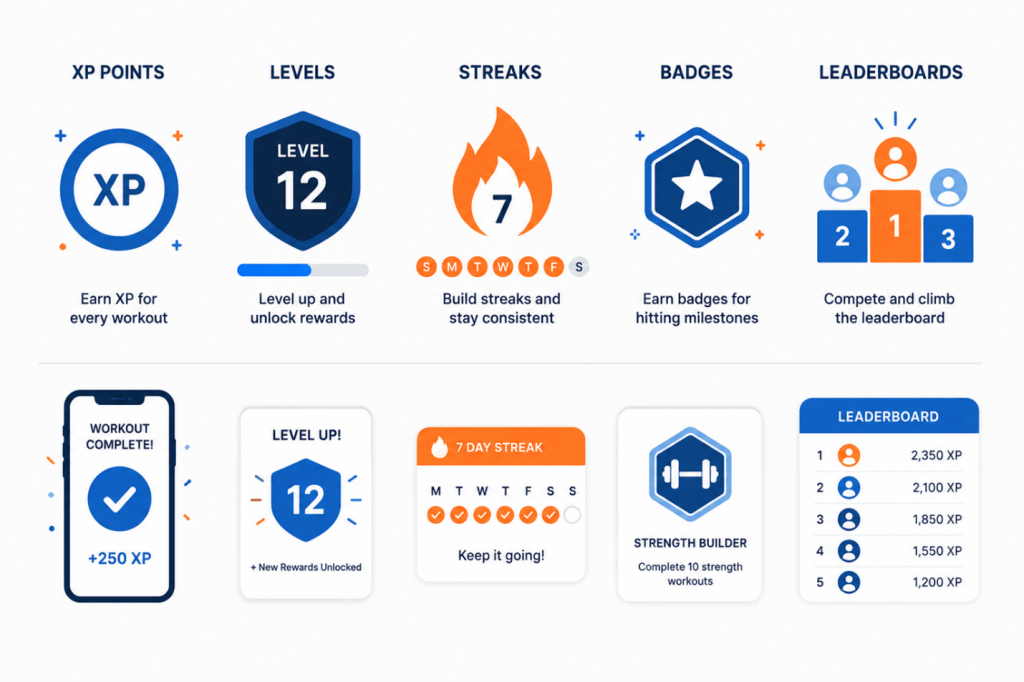
Gamifying your workout means adding point systems, streaks, levels, and friendly competition to your training so progress feels like leveling up in a game instead of checking off a chore. The most effective approach ties XP or points to real performance metrics (weight lifted, distance run, sessions completed) rather than just showing up, and combines that with at least one social element like a leaderboard or league.
Gamifying a workout means layering game mechanics, like points, levels, streaks, badges, and leaderboards, onto your training so that consistency and progress feel rewarding in the moment, not just in the long run.
This is different from simply tracking a workout. Logging your sets and reps in a notebook is tracking. Turning those same sets and reps into XP that levels you up, or into a streak you don’t want to break, is gamification.
The game elements that show up most often in research on fitness apps include:
| Game Element | What It Does | Motivation Type |
| Points / XP | Converts effort into a visible score | Extrinsic |
| Levels | Marks long-term progress in stages | Intrinsic + Extrinsic |
| Streaks | Rewards consistency, not just performance | Intrinsic |
| Badges | Recognizes specific milestones or skills | Extrinsic |
| Leaderboards | Adds social comparison and competition | Extrinsic |
| Progress bars | Shows how close you are to a goal | Intrinsic |
| Challenges/quests | Frames training as a task to complete | Intrinsic + Extrinsic |
Notice that the most effective systems mix both motivation types. That distinction matters more than it sounds, and it’s the reason some gamified routines stick while others get abandoned within a month.
Why Gamification Actually Works
Gamification works because it gives your brain a short-term reward loop for a behavior that normally only pays off long-term. Hitting a new PR, unlocking a level, or extending a streak triggers the same reward response as winning in a game, which makes you more likely to repeat the behavior tomorrow.
Research on gamified fitness apps has found that intrinsic motivations like self-development, self-control, and enjoyment are the strongest drivers of continued use, but social recognition and rewards also meaningfully boost it. The same study found something less commonly reported: when rewards like social recognition or financial incentives were voluntary, they actually strengthened people’s intrinsic motivation rather than replacing it.
In plain terms: a leaderboard or reward system doesn’t have to compete with your “real” motivation to get fit. Done right, it reinforces it.
How to Gamify Your Workout: A 5-Step Framework
Here’s a practical sequence for building a gamified system around your own training, whether you’re doing it with a notebook, a spreadsheet, or an app.
Step 1: Pick a Progress Metric Worth Tracking
Start by choosing one or two metrics that actually reflect improvement, not just attendance. Good options include total weight lifted per session, running pace, workout completion rate, or time under tension for strength work.
Avoid metrics that reward effort with no connection to outcome, like “minutes in the gym.” A metric tied to real progress is what separates a gamified workout from a glorified attendance tracker.
Step 2: Build a Points or XP System
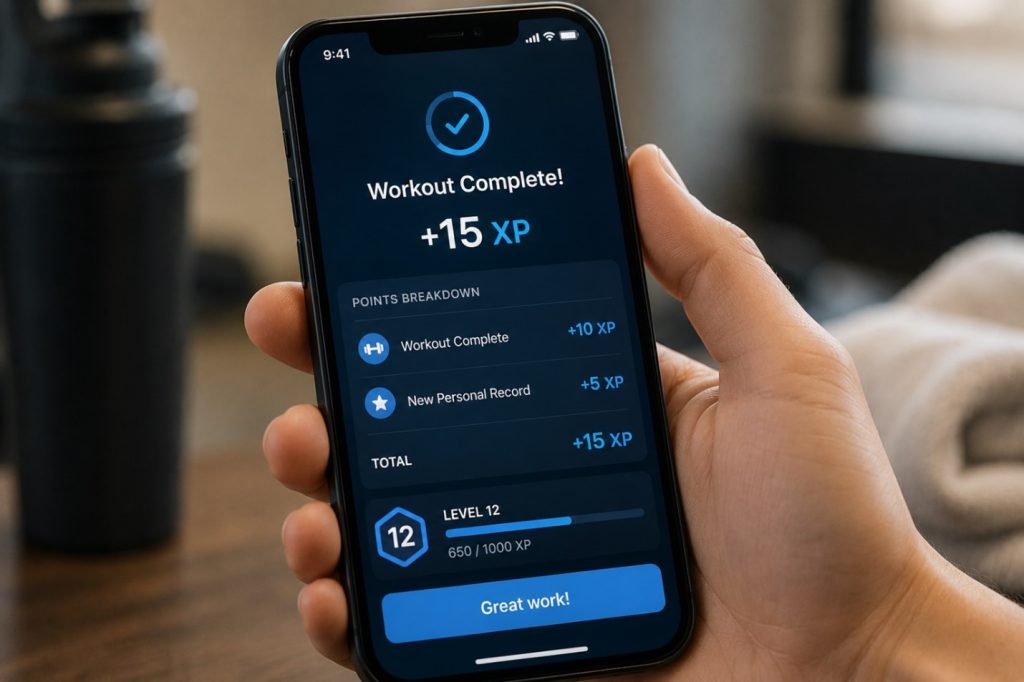
Assign point values to actions that matter. A simple starting structure:
- 10 XP for completing a planned workout
- 1 XP for every 5 lbs lifted above your previous best on a given lift
- 5 XP for hitting a target pace or distance on cardio days
- 15 XP bonus for completing a full week as planned
The goal is for your XP total to roughly mirror your actual training progress. If your XP goes up but your lifts and times stay flat, the system needs recalibrating.
Step 3: Set Up Streaks for Consistency
Streaks reward showing up, which matters because consistency is what produces results, not any single session. Track consecutive days or weeks where you hit your minimum target (for example, “at least 3 sessions this week”).
Build in a “streak freeze” or grace day for sickness or travel. Streak systems that punish a single missed day too harshly tend to get abandoned the first time life gets in the way, which defeats the purpose.
Step 4: Add Levels or Milestones
Group your XP into levels tied to meaningful thresholds, like every 500 XP unlocking a new “rank.” Where possible, connect levels to real capability changes (e.g., “Level 5: deadlift 1.5x bodyweight”) rather than arbitrary point totals alone.
This is where gamification becomes motivating over months, not just days. A level-up after a tough training block gives you a concrete marker of how far you’ve come.
Step 5: Bring in Competition
Add a social layer: a shared leaderboard with training partners, a head-to-head challenge, or a league-style format where groups compete over a set period. Social recognition, such as friends noticing achievements or rankings, was shown to meaningfully increase people’s intention to keep using a gamified fitness system.

Even a simple group chat where everyone posts their weekly XP total can create enough accountability to keep a streak alive on the days motivation is low.
When Gamification Can Backfire
Gamification isn’t risk-free, and most articles on this topic skip this part. Motivation crowding theory holds that extrinsic rewards can either strengthen or weaken intrinsic motivation, depending on whether people perceive them as supportive or controlling.
In practice, this shows up in a few common ways:
- Mandatory rewards feel like pressure. If hitting your XP target becomes something you “have to” do to avoid losing a streak or status, the reward can start to feel controlling rather than fun, which research links to reduced intrinsic motivation.
- Leaderboards can demotivate beginners. Comparing a first-month lifter’s totals to someone three years in can do more harm than good. Look for leaderboards that group people by experience level or improvement rate, not just raw totals.
- Points can drift from real progress. If your XP system rewards volume over quality, you can “win” the game while your actual fitness stalls or your form breaks down.
The fix isn’t to avoid gamification. It’s to keep the reward system optional, tied to real metrics, and grouped in a way that keeps competition fair.
Tools That Make This Easier
You can absolutely build a gamified system manually with a spreadsheet and a shared group chat, and plenty of people do. If you’d rather not build the scoring logic yourself, apps built around fitness gamification (Rival Fit included) handle the XP calculations, streak tracking, and leaderboard logic automatically, and let you join leagues with people at a similar level instead of the entire user base.
Whatever route you choose, the core principle stays the same: the game should reflect your training, not replace it.
Frequently Asked Questions
Does gamifying your workout actually help you stick to a routine?
Yes, when the system rewards real progress and consistency rather than just logging in. Studies on gamified fitness apps consistently link intrinsic motivators like self-development and self-control to higher intention to continue using the app long-term.
What’s the best XP system for a beginner?
Start simple: award points for completing planned workouts and for consistency (a weekly streak), and hold off on competitive leaderboards until you’ve built a baseline. Adding too many game elements at once can feel overwhelming before the habit is established.
Can a gamified app replace a personal trainer?
No. Gamification helps with motivation and consistency, but it doesn’t replace programming expertise, form coaching, or injury prevention guidance. Many people use both: a trainer or program for the “what,” and gamification for the “why keep going.”
Do gamified fitness systems work for older adults?
Yes. Research on wearable-based gamification, including step challenges and progress tracking, has shown increased physical activity among older adults, with pedometer-based tracking alone shown to meaningfully increase daily activity in clinical populations. Levels and milestones may need to be based on personal baselines rather than population averages.
How long does it take for a gamified routine to feel natural?
Most people report that streaks and points start feeling automatic after 3-4 weeks of consistent use, roughly the same timeframe commonly cited for habit formation in general. The key is keeping the system simple enough in the first month that it doesn’t become its own chore.
Conclusion
Gamifying your workout comes down to three things: track a metric that reflects real progress, build in rewards for consistency through streaks and levels, and add a social or competitive layer if it motivates you rather than discourages you. The research is clear that this works, but it’s not magic. A reward system that’s disconnected from your actual training, or one that feels mandatory rather than fun, can do more harm than good.
Start small. Pick one metric, assign it a point value, and track a streak for two weeks before adding anything else. If you want a system that handles the XP, streaks, and league matchups for you, that’s exactly what Rival Fit is built for.