
Quick Answer: The gym challenge ideas that hold up are the ones with a clear finish line, a visible leaderboard, and a way to track effort that isn’t a whiteboard someone forgets to update by week two. Below are 17 challenge ideas across individual, team, and nutrition formats, plus how gym operators run them without turning it into a second job.
If you’ve run a gym challenge before, you already know the pattern. Week one, sign-ups are strong and the whiteboard is full. Week two, half the entries stop updating. Week three, the challenge quietly dies and nobody announces a winner. The idea wasn’t the problem. The tracking was.
Good gym challenge ideas for members don’t fail because members lack motivation. They fail because most gyms run them the same way they did a decade ago: a clipboard, a shared spreadsheet, or a whiteboard near the front desk that depends on someone remembering to update it. The moment tracking becomes a chore for staff, the challenge becomes the first thing that slips when the gym gets busy. For a deeper look at why challenges specifically stall out after a strong start, see our breakdown of fitness challenges that actually work.
Why Do Gym Challenges Fail Before They Finish?
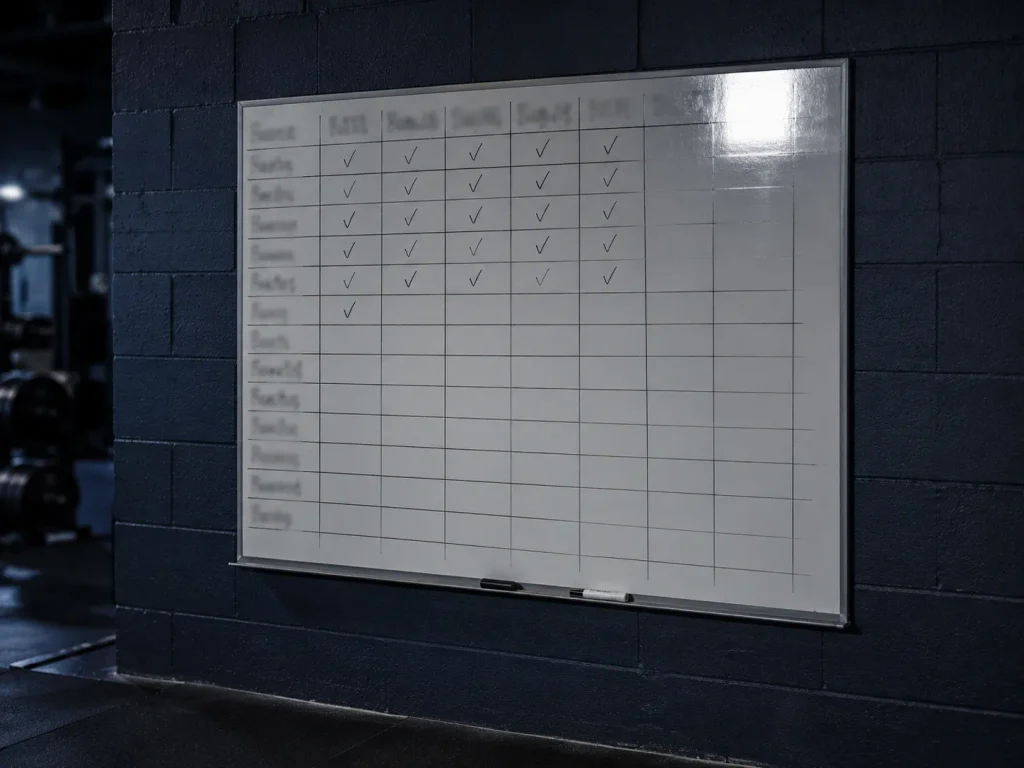
Three things kill a challenge almost every time: no visible progress, no clear deadline, and tracking that depends on a staff member’s memory instead of the members themselves. A whiteboard only updates when someone walks over and writes on it. A spreadsheet only updates when a trainer remembers to enter it after close. Members lose interest days before the challenge officially ends, because they can’t see where they actually stand.
The fix isn’t a better whiteboard. It’s tracking that updates itself as members train, so the leaderboard is accurate the moment someone finishes a set or a run, not whenever staff catches up on data entry.
Individual Challenge Ideas for Members

- 30-day consistency streak. Reward members for showing up a set number of days in a row, not for hitting a specific performance number.
- PR chase. Give members four weeks to beat a personal record on one lift, tracked and announced weekly.
- Mileage club. Total running or rowing distance over a month, open to any pace or experience level.
- Progressive overload challenge. Members log the same lift weekly and the challenge tracks total weight moved over the month, not just a single max.
- AMRAP finisher. A set circuit with a time cap, scored by rounds completed, run once a week for four weeks.
Team and Group Challenge Ideas for Members

- Team mileage pool. Small teams combine running, cycling, or rowing distance toward a collective goal.
- Gym vs. gym. If you run multiple locations, pit them against each other on total logged workouts for the month.
- Class attendance league. Teams earn points for group class attendance, rewarding consistency over intensity.
- Relay-style rep challenge. Teams split a large rep total (10,000 burpees, for example) across members and track combined progress.
- New member buddy challenge. Pair a new sign-up with an existing member for their first 30 days, both earning credit for the new member’s consistency.
Nutrition and Wellness Challenge Ideas for Members
- Protein target streak. Reward members for hitting a daily protein goal a set number of days, not for weight change.
- Hydration and sleep check-in. Simple daily boxes for water intake and sleep hours, aimed at members who need a lower-intensity entry point.
- Macro consistency challenge. Track how many days members land within their target range rather than chasing a single “perfect” day.
- Recovery week challenge. A deload-focused challenge built around mobility work, sleep, and light movement, useful for members returning from injury or a long break.
How Do You Run a Gym Challenge Members Actually Finish?
Every idea above works better with three things in place: a leaderboard members can check without asking staff, scoring that updates automatically instead of manually, and a way for trainers to see standings at a glance instead of digging through a spreadsheet at the end of the month.
That’s the gap the Trainer Command Center is built for. Instead of a whiteboard or a shared spreadsheet, a trainer builds the challenge as a program, and every logged workout, run, or macro entry from the Workout Journal, Runner Log, and Macros & Nutrition feeds it automatically. Members see exactly where they stand, and the trainer sees every athlete’s status from one dashboard instead of chasing updates. The same Unified XP scoring that powers Rival Fit’s gamification approach is what keeps a member-run challenge and an individual’s regular training pulling in the same direction instead of living in two separate systems.
| Whiteboard or Spreadsheet Challenge | Trainer Command Center | |
| Who updates scores | Staff, manually, after the fact | Updates automatically as members log activity |
| Member visibility | Only visible at the gym | Visible any time, from a phone |
| Standings accuracy | As current as the last manual update | Reflects each logged rep, run, or meal |
| Trainer effort | Data entry on top of coaching | One dashboard, no re-entry |
Frequently Asked Questions
How long should a gym challenge run?
Two to four weeks works for most formats. Long enough to build a habit, short enough that members don’t lose momentum before it ends.
What’s the easiest gym challenge to start with?
A 30-day consistency streak. It rewards attendance rather than performance, so it works across fitness levels and doesn’t require members to already be advanced.
Do gym challenges actually help with retention?
Members who participate in structured gym challenges tend to show lower dropout rates than members who don’t, largely because a challenge gives members a specific reason to keep showing up during the weeks motivation naturally dips. It’s one of the more consistent findings across gym retention research.
Can nutrition challenges run alongside workout challenges?
Yes. Running a protein or hydration challenge at the same time as a workout challenge tends to reinforce both, since members who are dialing in nutrition often show up more consistently to train too.
Do challenges need a prize to work?
No. Visible progress and a real deadline motivate most members on their own. A prize can help, but it’s not the part doing the actual work.
The Bottom Line
The gym challenge ideas themselves aren’t the hard part, there are dozens of solid formats to choose from. The part that actually determines whether a challenge finishes is whether members can see accurate, current standings without a staff member manually updating a board.
That’s what the Trainer Command Center replaces: a challenge built once, tracked automatically through Unified XP, with every trainer able to see exactly where each athlete stands. Want to see how members compete against each other once the challenge is live? Our guide to competing with friends at the gym breaks down the formats that keep it fun instead of intimidating. Claim your spot and see what a challenge looks like when it runs itself.