
Quick Answer: Staying active after 60 comes down to five decisions: how much to do, what to do, how to stay motivated, how to track it, and who to do it with. U.S. guidelines call for 150 to 300 minutes of moderate aerobic activity a week, muscle-strengthening on at least two days, and balance work, and they say some activity is better than none. Start with your doctor, build up gradually, track your own trend, and find a group. This guide summarizes each step and links to the detailed posts.
There’s plenty of advice about exercising after 60, and most of it covers one piece: a workout, an app, a motivational tip. Staying active over years takes five pieces working together. This guide walks through all five, summarizes what the research says, and links to the full post on each.
It’s general information, not medical advice. Talk to your doctor before starting or changing an exercise routine, especially with a chronic condition or after a long period of inactivity.
How Much Physical Activity Do Adults Over 60 Need?
The U.S. Department of Health and Human Services’ Physical Activity Guidelines for Americans apply to older adults, with one addition: balance training. The key point is that some activity is better than none, and you can build toward the targets over time.
| Type of Activity | What the Guidelines Say | Examples |
| Aerobic | 150 to 300 minutes a week of moderate intensity, or 75 to 150 minutes of vigorous, or an equivalent mix | Brisk walking, water aerobics, cycling |
| Muscle-strengthening | At least two days a week, involving all major muscle groups | Resistance bands, light weights, body-weight exercises |
| Balance | Multicomponent activity that includes balance training as part of the week | Tai chi, standing balance work |
| If you can’t reach 150 minutes | Be as active as your abilities and conditions allow | Whatever your doctor says is comfortable |
What Should You Actually Do?
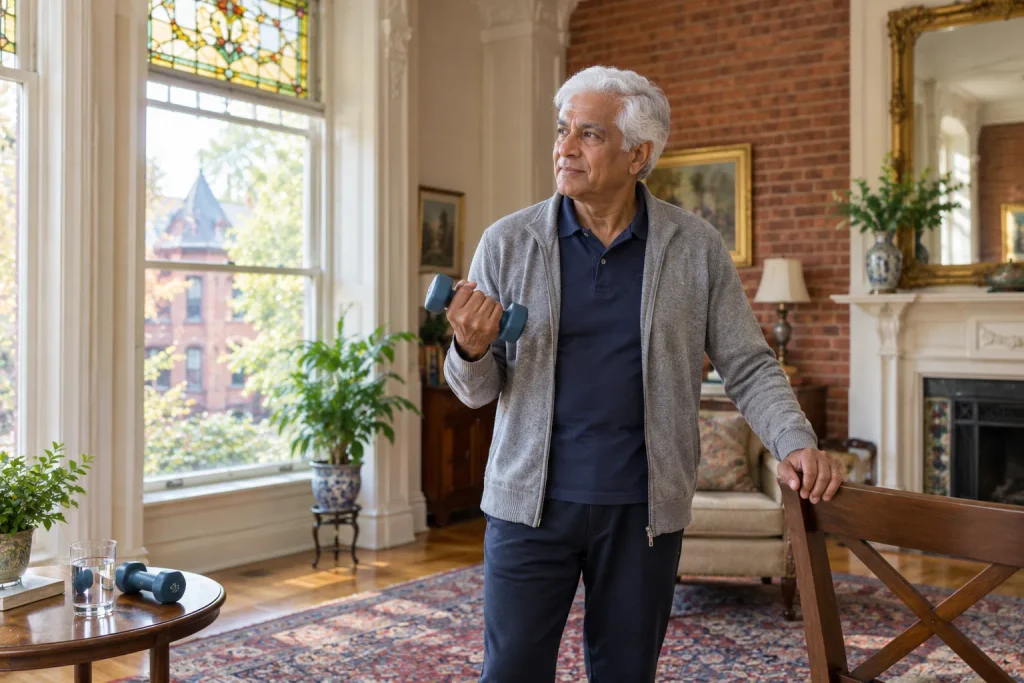
Aerobic, strength, and balance work all count, and each has a tracking angle that makes it easier to stick with.
For walking and other gentle aerobic work, a meta-analysis of 15 studies found that among adults 60 and older, mortality risk fell as daily steps rose until about 6,000 to 8,000 steps, with no definitive link to walking speed beyond total steps. That’s an association, not proof, and it isn’t a personal target. We cover what a good tracker should reward in low-impact workout trackers.
For strength, tracking effort matters as much as weight. In an 11-week study of 82 older adults, progressing by perceived effort built strength as well as other methods and was more enjoyable. Our guide to strength training for seniors covers what to log and how to know when to add weight. It’s about tracking, not form, so get form coaching from a qualified trainer or physical therapist.
Balance is the piece most apps skip, and the guidelines call it out for older adults. Evidence-based programs such as Tai Ji Quan: Moving for Better Balance are built around it, and our guide to senior fitness groups shows how to find one. Ask your doctor before starting balance work if you’ve had falls.
How Do You Stay Motivated Past the First Few Months?

Generic advice like “find your why” skips what the research on older adults actually points to: three needs, autonomy (choosing your own pace), competence (seeing real progress), and relatedness (connection with other people). Research suggests connection matters most early, and visible progress matters more later. We unpack this in how to stay motivated to exercise after 60.
How Do You Track Progress Without Getting Discouraged?
Compare yourself with yourself. Rankings that mix older beginners with young athletes tend to discourage everyone but the people at the top, as covered in fitness leaderboard psychology. Weekly goals also survive a sick day better than daily streaks, which is the idea behind why workout streaks work. For a wider look at how points, levels, and rankings affect motivation, see our guide to gamification in health and fitness.
If you want an app, our honest comparison of fitness apps for seniors judges tools on readability, low-impact logging, and whether they force comparison with strangers.
Where Can You Find People to Exercise With?

Start local. The Eldercare Locator connects you with your Area Agency on Aging, and senior centers and city parks departments run classes. SilverSneakers is included with many Medicare Advantage plans, and the National Council on Aging lists evidence-based programs such as EnhanceFitness. Our guide to senior fitness communities and groups names verified options and explains how a friendly league differs from a class.
It’s worth the effort. In a study of 12,944 participants in evidence-based fall prevention programs, people who attended more sessions reported less loneliness afterward. That’s an association, but it supports choosing a group you enjoy.
Where Does Rival Fit Fit In (and Where Doesn’t It)?
Rival Fit is a gamified fitness app where lifting, running, and nutrition earn Unified XP, which moves you up a state leaderboard that re-evaluates every Monday. The free Free Agent tier ($0 per month) includes ghost rank, which compares you with your own past performance, plus a workout journal and GPS run tracking. Custom Leagues, a Pro Athlete feature ($9.99 per month), let a group you choose compete together.
Its limits for this audience are real. There are no senior-only or age-matched leagues. There’s no instructor and no seated or balance routines, so pair it with a class or program for those. The site doesn’t say how walking is scored. It isn’t covered by Medicare, and it’s still in beta, with leagues opening first in Florida, Texas, and New York.
What Does a Simple Starter Plan Look Like?

This is a sample structure, not a prescription. Adjust it with your doctor.
1. Week 1: get clearance and pick one thing. Talk to your doctor, then choose one activity you enjoy and do it a few days this week.
2. Week 2: add strength. Two short sessions with a simple log of what you did and how hard it felt.
3. Week 3: add people. Join a class or group, or arrange a regular walk with a friend.
4. Week 4: review and add balance. Look at your trend, then add balance work at a pace your doctor and instructor are comfortable with.
Frequently Asked Questions
How much exercise do adults over 60 need?
U.S. guidelines recommend 150 to 300 minutes of moderate aerobic activity a week, muscle-strengthening on at least two days, and balance training as part of the week. If you can’t reach that, be as active as your abilities and conditions allow.
Where should I start if I haven’t exercised in years?
Start with your doctor, then begin with short, comfortable sessions and build up gradually. The guidelines say to increase activity over time, and some activity is better than none.
What if I have a chronic condition?
The guidelines say older adults with chronic conditions should be as physically active as their abilities and conditions allow. Ask your doctor what’s appropriate, and consider a program led by trained instructors.
Is walking enough?
Walking covers the aerobic part. The guidelines also call for muscle-strengthening on at least two days a week and balance training, which walking alone doesn’t provide.
How do I stay consistent?
Give yourself choices, track progress against your own past, and find people to do it with. Research on older adults points to autonomy, competence, and connection as the drivers.
Start Where You Are
Staying active after 60 isn’t about one perfect workout. It’s about a sustainable mix of aerobic, strength, and balance activity, a way to see your own progress, and people to share it with. Start where you are, build gradually, and check with your doctor along the way.
Want a friendly way to track your training against your own past self? Claim your spot and start with Free Agent when your state’s beta opens.