
Quick Answer: Fitness leaderboards work because they trigger competence, social accountability, and loss aversion, the same drivers behind habits like checking a streak count. But research also shows a flat, permanent leaderboard backfires: the bottom 80% of users disengage once the gap to the top looks unclosable. The fix is a tiered, resettable ranking, which is exactly what Rival Fit’s State League and Monday reset are built around.
Seeing your name next to a number changes what you do next. That’s not a marketing line, it’s a well documented finding across gamification research, and it explains why fitness apps keep building leaderboards even though half of them get the design wrong. A leaderboard can turn a Tuesday morning workout into something you don’t want to skip. It can also do the opposite: quietly convince someone at rank 4,000 that showing up doesn’t matter.
The difference isn’t the leaderboard itself. It’s how it’s structured. This post breaks down what the psychology research actually says about fitness leaderboard motivation, where most apps get it wrong, and how a tiered, state based ranking system changes the outcome.
Why Do Fitness Leaderboards Actually Work?
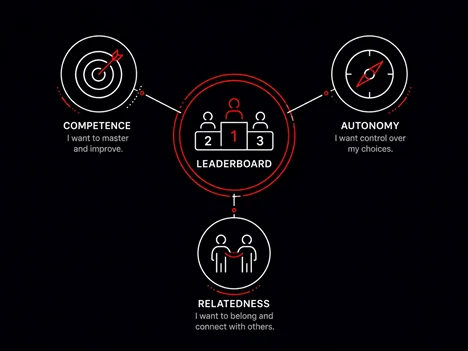
Leaderboards work because they satisfy three basic psychological needs: competence, autonomy, and relatedness. Interview based research on fitness app users found that people stick with apps that make them feel capable, in control, and connected to others, not apps that just track numbers in isolation.
A leaderboard adds a fourth lever on top of that: social accountability. Once your activity level is visible to other people, your absence becomes visible too. Researchers studying platforms like Fitbit found that this self revelation is a big part of why leaderboards change behavior. It’s harder to skip a workout when someone else can see you skipped it.
This is the same underlying mechanism behind workout streaks (loss aversion, the discomfort of losing progress you’ve already built) and behind Rival Fit’s Unified XP score. Rank and streaks both work because they make effort visible and comparable, not because a number by itself is motivating.
What Makes a Leaderboard Motivating Instead of Demoralizing?
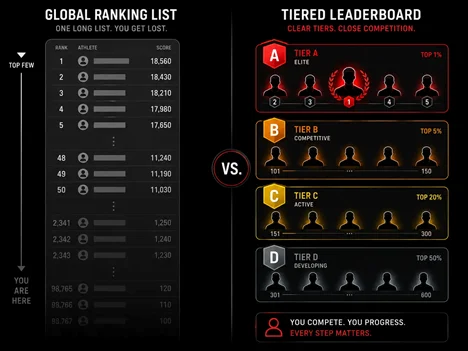
A leaderboard motivates the people near the top and demoralizes everyone else, unless it’s scoped correctly. That’s the core finding across most of the recent gamification research: global, unfiltered rankings reward a small percentage of users and disengage the rest.
Academic research comparing leaderboard formats found that absolute leaderboards, the kind that show everyone’s score on one continuous list, tend to highlight the gap between top and bottom performers. When that gap looks too large to close, people stop trying to close it. Relative or tiered formats, where you’re only compared to people near your own level, avoid that trap.
Here’s how the common approaches stack up:
| Leaderboard Type | What It Feels Like for Most Users | Best Used For |
| Global, all-time ranking | Motivating for the top few percent, demoralizing for everyone else | Short campaigns or one-off events, not ongoing engagement |
| Static ranking with no resets | Early joiners build a permanent lead new users can’t catch | Not recommended for long-term products |
| Tiered ranking with regular resets | Groups you with people close to your level, realistic shot each cycle | Weekly or seasonal competition |
| Self-comparison (ghost rank) | Removes social pressure, tracks your own trend line instead | Beginners, or anyone easing back in after time off |
Interestingly, some experimental research has also found that people can show more short term engagement when matched against someone with a different score rather than an identical one. The effect isn’t universal though, it depends heavily on how competitive the individual person is. That’s one reason a single leaderboard design rarely fits every user.
Can a Fitness Leaderboard Actually Backfire?

Yes, and this is the part most fitness apps skip over. Research on leaderboard design has found that seeing a low, static rank accumulates as a perception of repeated failure over time, especially for users near the bottom of a global ranking. Instead of pushing harder, they quietly disengage.
This lines up with a broader pattern researchers call upward comparison: when someone’s rank gap to the top of the board looks insurmountable, they don’t get inspired, they check out. It’s the same reason a beginner walking into a gym full of visibly stronger lifters is more likely to feel discouraged than motivated on day one.
The fix isn’t removing competition. It’s bounding it. A ranking that resets on a schedule, groups users by tier instead of a single global list, and gives people a path back up after a bad week solves most of the demotivation problem without losing the accountability that makes leaderboards work in the first place.
How Rival Fit’s State League and Ghost Rank Apply This
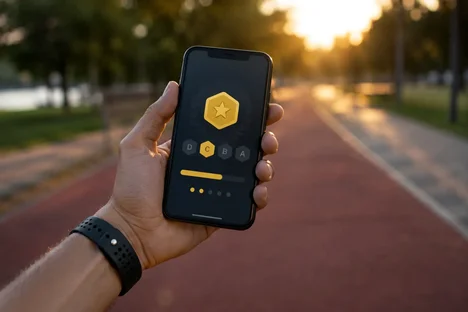
This is exactly the gap the State League System is built to close. Instead of one global leaderboard where a new user is buried under thousands of established athletes, you’re placed in your state pool starting in Tier C. You’re competing against people at a comparable stage, not against everyone who’s been on the platform for a year.
The Monday reset matters here too. A leaderboard that never resets is exactly the static ranking, permanent gap problem the research flags. Rival Fit’s weekly reset means last week’s rank doesn’t lock you out of this week’s competition, you get a real shot at climbing from Tier C toward Tier A on a recurring basis, not a one-time chance you missed months ago.
For anyone who isn’t ready for social comparison at all, ghost rank offers the self-comparison path the research points to as effective for beginners: you’re measured against your own past performance first. That’s part of the Free Agent tier from day one, no social pressure required to start earning Unified XP.
And because Unified XP combines lifting, running, and nutrition discipline into one balanced score instead of three separate leaderboards, you’re not managing three different rank anxieties at once. Most competing apps treat those as separate systems. Rival Fit’s whole thesis is that separating them is part of why other gamified apps don’t stick, you can see the Unified XP breakdown and the streak psychology behind the Monday reset for more on how these pieces connect. If you want the full walkthrough of turning a plain workout into a competitive system, how to gamify your workout covers the basics this post builds on.
Once your state’s league is live, your Standings show exactly where you sit in Tier C, B, or A, updated as XP comes in.
Frequently Asked Questions
Does having a leaderboard actually make you work out more?
For most people, yes. Research on wearable fitness data found a consistent positive effect from ranking near the top of a leaderboard, and importantly, users who never rank first aren’t harmed by the leaderboard either. The upside is real, the risk is mainly in poor leaderboard design, not the concept itself.
Why do I feel discouraged instead of motivated by a fitness leaderboard?
This usually happens with global, unscoped leaderboards where the gap between your rank and the top feels too big to close. Psychologists call this an upward comparison problem. Tiered systems that group you with people at a similar stage are designed to avoid this exact effect.
What’s the difference between a global leaderboard and a tiered one?
A global leaderboard ranks every user on one continuous list, which tends to reward only the top few percent. A tiered leaderboard, like Tier C, Tier B, and Tier A, groups people by skill or progress level so more users are competing against realistic peers instead of the platform’s most established athletes.
Can I get the benefits of a leaderboard without comparing myself to strangers?
Yes. Self-comparison formats, tracking your own trend over time instead of ranking against other people, are effective for beginners and anyone who finds social comparison stressful. That’s the idea behind ghost rank.
How often should a fitness leaderboard reset?
Weekly resets tend to work well because they prevent a permanent gap from forming between early adopters and everyone else. A rolling reset gives every user a realistic shot at climbing each cycle instead of chasing a lead that was built up months earlier.
The Bottom Line
Leaderboards aren’t inherently motivating or demoralizing, the structure decides which one you get. Global, static rankings reward a small group and quietly push everyone else out. Tiered, resettable systems paired with a self-comparison option keep the accountability that makes competition work without the burnout that makes people quit.
That’s the design behind Rival Fit’s State League, Monday reset, and ghost rank. If you want to see where you’d start, claim your spot and get placed in your state’s Tier C pool when your league opens.